
CIOReview Europe Weekly Brief
Be first to read the latest tech news, Industry Leader's Insights, and CIO interviews of medium and large enterprises exclusively from CIOReview Europe
Codegate
Redefining Asset Integrity in Asset-Intensive Industries
Every asset counts on a busy manufacturing floor, maintenance operation or in a motorsports facility. A missing part can stall a job, drive up costs, or affect production. The challenge is in tracking every asset in real time, and Codegate’s Lime handles it effortlessly. By connecting RFID tags, sensors, handhelds and fixed readers to enterprise systems, Codegate’s Lime acts as a middleware to track each component for precise locating. Teams always know where assets are and when they will be needed. What sets Lime apart is how it works with the systems teams already use. Instead of replacing them, it adds a smarter, faster layer that makes platforms more reliable and capable. Every asset is logged in a complete audit trail, which is crucial for compliance in defence, government and other regulated sectors. Paired with Codegate’s eVantage Manager, Lime adds even more confidence. Systems are continuously monitored and validated, freeing teams from second-guessing the data and allowing them to focus on higher-value work. “Codegate’s core business is software development and systems integration, so joining up data sources is in our DNA,” says Graham Fenton, managing director. One View, Zero Gaps Asset management tools perform well once they have accurate data. The real challenge is collecting that data without burdening teams with time-consuming manual tasks. Many systems still rely on manual data entry, which leads to sporadic updates and gaps in information. The longer the delay between asset movement and data entry, the greater the risk of misplaced or unaccounted for items. Lime solves this problem by connecting to various automated data collection technologies, including RFID, ultrawideband, Bluetooth Low Energy and barcodes. It then standardises the incoming data in a central SQL database, making it ready for integration with enterprise systems through a robust API. This approach allows organisations to deploy different detection technologies in various environments while unifying the results in a cohesive view.
Digital Magazine
AI-Powered Semantic Data Platform of The Year in Europe 2025
Almato
Redefining Enterprise Intelligence with Semantic Precision and AI Reasoning
Christian Sauter, CEO, Almato
The value of data is universally acknowledged across industries and governments. Yet, turning data into clear, actionable insight remains a challenging task. Information is often trapped in silos or stripped of context by rigid pipelines, leading to delays, fragmented insights and missed opportunities. Almato’s Bardioc was created to break this cycle. The semantic data platform supports data-driven business models and AI applications, allowing organisations to transform complex datasets into a foundation for clarity, action and growth. “With Bardioc, clients gain strategic advantage where others still struggle with fragmented insights,” says Christian Sauter, CEO. For over two decades, Almato has pioneered digital innovation, expertly transforming intricate business processes into seamless digital operations for leading enterprises and public sector organisations. Clients benefit from its deep expertise and decades of experience in delivering complex digitalisation projects. It enables them to shift from reactive operations to proactive value creation without the long delays typical of enterprise transformation. Almato is a leading provider of a semantic data platform that powers data-driven business models and advanced AI applications. It also offers a unique reasoning engine for agentic AI. Turning Complexity into Clarity Bardioc introduces a new way of creating value and actions from data: semantically structured, instantly usable and built to evolve. At its core is an AI reasoning engine that applies human logic to draw inferences and make informed decisions. Each stage is transparent and auditable, embedding compliance, documentation and accountability. The platform’s ontology-first architecture treats data as knowledge, ready for reuse across the enterprise. A single semantic layer connects and contextualises information from diverse systems, removing the need for repeated extraction and transformation. Once a dataset is linked to this layer, it becomes available for new use cases, AI models and operational systems without additional integration. Insights generated in one department enrich the entire organisation’s knowledge base, enabling faster and more accurate decisions across all functions while reducing IT overhead. The platform offers full support for domain-specific languages (DSLs), enables organizations to extend or evolve their ontologies at any time, and provides built-in processes to ensure continuous semantic development. Leveraging the semantic layer, it organises decision logic into modular knowledge items and links them across systems for robust, context-aware automation..

IoT

Why ERGO shifted to an end-to-end AI approach
Mark Klein, Chief Digital Officer (CDO), ERGO Group
Cloud

Data-Driven Insurance Companies Need to Speed Up Their Transition to the Cloud
Kjetil Kalager, Head of Data and AI, Fremtind
IoT

Digital Asset Management (DAM)
Antonis Giannopoulos, Chief Information Officer, METRO AEBE
Data Observability Platform

Navigating the Implementation of AI and ML
AgustínIzquierdo, Business Intelligence and Data Management Director, Campofrio Food Group
Conversational AI

Leveraging AI, Data Ecosystems and Strategic Technology Integration
Janne Lautanala, Chief Ecosystem and Technology Officer, Fintraffic

IN MY OPINION
IoT
R&D can be the Spearhead of Innovation for AI. However, We Need a Global Approach to Bring Value to Manufacturing
Athanasios Kontopoulos, Computational & Data Science Scientific Director, R&D, and International Fellow, Air Liquide

LAST WORD
Security
Web Development in Cloud Environments: A Corporate Perspective
David Guerra Rodriguez, Software Development Manager, Applus+ IDIADA
IN FOCUS

Transforming Information Management with Semantic AI in Europe
Semantic AI platforms in Europe enhance data integration, compliance, and interoperability, supporting strategic innovation and responsible data use across industries and multilingual environments.

Growing Demand for Asset Tracking Solutions in Europe
Asset tracking solutions in Europe are proliferating, driven by regulatory compliance, operational efficiency, and technology advancements, improving visibility across various industries like logistics, healthcare, and manufacturing.
EDITORIAL
When Data Learns the Language of Assets
The real question has shifted in industries built on high-value equipment, whether powering grids, running hospitals, or keeping global supply chains in motion. It is more about what condition the equipment is in, how it is connected to the wider system, and what decisions must be made before failure occurs.
The convergence of semantic data platforms and AI-powered asset tracking fuels that shift.
Modern semantic platforms are teaching data in their own language. Machine learning refines signals into coherent categories that mirror how organisations think about their business. In practice, enterprises are moving from static records to real-time intelligence, embedding semantic enrichment directly into asset telemetry, deploying prescriptive AI to act before downtime, and exposing definitions of “uptime” or “failure state” through interoperable APIs that remain consistent across partners and systems.
This is a story of not only efficiency but also trust. Trust that a scanner will be ready when a patient is waiting, trust that turbines will deliver when the grid peaks, and trust that compliance records will stand firm under audit.
The magazine features a thought-provoking article by Mark Klein, chief digital officer (CDO) at ERGO Group, highlighting the role of data science from isolated model-building to a disciplined end-to-end process. Additionally, an article by Cameron Farrar, vice president - head of software asset management at Marsh McLennan, discusses how Software Asset Management (SAM) is a rapidly evolving discipline that is moving beyond legacy software oversight to become a strategic enabler of cloud adoption, cost control, compliance, and vendor relationships.
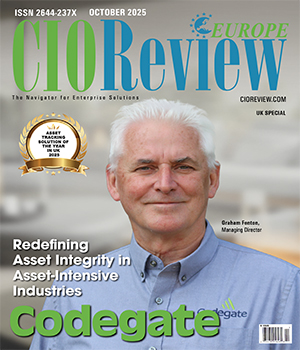
The publication spotlights Codegate as the cover feature, recognising its expertise in providing intelligent asset-tracking solutions that connect RFID, sensors and handheld devices to enterprise systems. These solutions deliver real-time visibility, audit trails and actionable insights that reduce misplacement, streamline operations and enhance accountability.
We hope this edition offers insights that help industry leaders and innovators navigate change, build resilience, and stay prepared for what’s next in a world where semantic data platforms, AI-powered asset intelligence, and digital twins redefine the future of readiness, sustainability, and trust in critical systems.
