

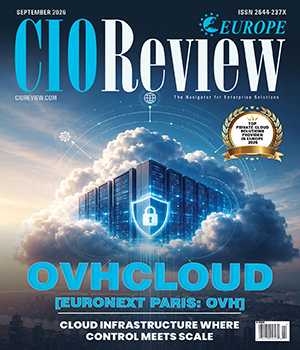
OVHcloud [Euronext Paris: OVH]
Cloud Infrastructure Where Control Meets Scale

Cloud infrastructure becomes harder to manage when organizations need dedicated resources, strong security controls and room to expand without surrendering visibility. OVHcloud [Euronext Paris: OVH] approaches that equation through a European model built around dedicated infrastructure, data sovereignty and control across the technology stack. It designs its own servers, operates its own data centers and its network and offers private, public and bare-metal environments that can be combined for workloads.
That vertically integrated model gives OVHcloud a direct role in the infrastructure supporting its cloud services. Its investor materials describe control of the value chain as a way to combine performance, predictable pricing, flexibility and scalability. The model also extends to infrastructure design, including liquid cooling and server lifecycle management, making the private cloud proposition part of a broader technology strategy.
That broader technology strategy increasingly includes artificial intelligence. “It became quite clear to us that if we don't master this technology, we can't guarantee our future,” says Octave Klaba, founder, chairman and CEO.
Hosted Private Cloud brings that approach into a dedicated environment. OVHcloud’s service brings together dedicated cloud infrastructures that are automatically deployed and can be customised for professional workloads. Customers receive a ready-to-use environment, at least a 99.9 percent SLA and the ability to add resources as workloads change. Sensitive data is hosted on dedicated physical machines in certified data centers for sensitive workloads.
Private Cloud Built Around Dedicated Resources
OVHcloud's VMware portfolio illustrates how it translates dedicated infrastructure into managed environments. Its offering includes managed VMware vSphere, VMware Cloud Foundation and a stretched three-availability-zone cluster. The three-AZ option targets essential services requiring maximum resilience and strict recovery objectives, with a stated 99.999 percent SLA. Customers can select an architecture according to the availability requirements of a workload and provide a managed path from infrastructure to applications.
The platform also supports Nutanix on dedicated hosts, with both packaged options and Bring Your Own License configurations. OVHcloud combines Nutanix Cloud Platform software with dedicated infrastructure managed by its teams, giving customers a hyperconverged private cloud without the day-to-day burden of maintaining the underlying physical environment. At the same time, customers retain control over their data and continue using familiar management tools, making the transition easier for enterprise teams.
SAP HANA adds another route for enterprise workloads requiring a specialized environment. OVHcloud offers SAP HANA on private cloud and bare metal, including TDI-compliant servers. Its portfolio also connects to backup and disaster recovery technologies such as Veeam and Zerto. The result is a set of infrastructure choices matched to application, recovery and compliance requirements while giving enterprise teams options for continuity planning.
Sovereignty Embedded in the Infrastructure
Data location is central to OVHcloud's trusted cloud proposition. Its private cloud offering places sensitive data on dedicated physical machines in certified data centers, while customers can choose where data is stored and the jurisdiction that protects it. Its SecNumCloud-qualified portfolio extends this model into environments designed for stringent security requirements, including dedicated VMware, Nutanix and SAP configurations for organizations operating under sector-specific or national requirements.
That vertically integrated model gives OVHcloud a direct role in the infrastructure supporting its cloud services. Its investor materials describe control of the value chain as a way to combine performance, predictable pricing, flexibility and scalability. The model also extends to infrastructure design, including liquid cooling and server lifecycle management, making the private cloud proposition part of a broader technology strategy.
That broader technology strategy increasingly includes artificial intelligence. “It became quite clear to us that if we don't master this technology, we can't guarantee our future,” says Octave Klaba, founder, chairman and CEO.
Hosted Private Cloud brings that approach into a dedicated environment. OVHcloud’s service brings together dedicated cloud infrastructures that are automatically deployed and can be customised for professional workloads. Customers receive a ready-to-use environment, at least a 99.9 percent SLA and the ability to add resources as workloads change. Sensitive data is hosted on dedicated physical machines in certified data centers for sensitive workloads.
Private Cloud Built Around Dedicated Resources
OVHcloud's VMware portfolio illustrates how it translates dedicated infrastructure into managed environments. Its offering includes managed VMware vSphere, VMware Cloud Foundation and a stretched three-availability-zone cluster. The three-AZ option targets essential services requiring maximum resilience and strict recovery objectives, with a stated 99.999 percent SLA. Customers can select an architecture according to the availability requirements of a workload and provide a managed path from infrastructure to applications.
The platform also supports Nutanix on dedicated hosts, with both packaged options and Bring Your Own License configurations. OVHcloud combines Nutanix Cloud Platform software with dedicated infrastructure managed by its teams, giving customers a hyperconverged private cloud without the day-to-day burden of maintaining the underlying physical environment. At the same time, customers retain control over their data and continue using familiar management tools, making the transition easier for enterprise teams.
SAP HANA adds another route for enterprise workloads requiring a specialized environment. OVHcloud offers SAP HANA on private cloud and bare metal, including TDI-compliant servers. Its portfolio also connects to backup and disaster recovery technologies such as Veeam and Zerto. The result is a set of infrastructure choices matched to application, recovery and compliance requirements while giving enterprise teams options for continuity planning.
Sovereignty Embedded in the Infrastructure
Data location is central to OVHcloud's trusted cloud proposition. Its private cloud offering places sensitive data on dedicated physical machines in certified data centers, while customers can choose where data is stored and the jurisdiction that protects it. Its SecNumCloud-qualified portfolio extends this model into environments designed for stringent security requirements, including dedicated VMware, Nutanix and SAP configurations for organizations operating under sector-specific or national requirements.
The SecNumCloud Private Cloud proposition combines VMware, Nutanix and SAP in an ANSSI-qualified Trusted Zone. Bare Metal Pod provides another isolated, SecNumCloud-qualified environment, while the SNC Cloud Platform brings a cloud-native experience into the same security framework. These offerings connect infrastructure design with regulatory and sovereignty requirements instead of treating compliance as a separate layer across infrastructure, virtualization and workload placement decisions.
The approach also preserves interoperability. Its open, reversible cloud uses standard APIs and supports hybrid architectures that combine private cloud, public cloud and dedicated servers. Customers can place workloads in different environments and connect them through OVHcloud networking capabilities, giving applications different performance, security or data-location characteristics without forcing one deployment model while retaining flexibility as application architectures evolve.
Private Cloud in Practice
The value of this architecture is evident in how customers use it in practice. TIPCO Treasury and Technology runs its financial platform on an OVHcloud software-defined data center across facilities in Germany and France. The setup combines Intel hardware with VMware technology, while hosts can be added or removed as demand changes. Its SDDC also uses VMware Enterprise and NSX for virtual network functions, helping maintain business continuity when additional capacity is needed in another region.
Wokati Technologies provides another example. Its virtual desktop infrastructure was built entirely in OVHcloud Private Cloud and hosted in Roubaix, France. VMware vSphere enabled rapid deployment and configuration of new virtual machines, while application presentation time for its wokatiBox fell from one minute to 20 seconds. The customer also reported savings of 10 to 20 percent compared with a public cloud infrastructure for teams balancing application speed with infrastructure cost.
Public-sector workloads demonstrate another dimension of the model. The urban community of Bourget Airport in France used seven Hosted Private Cloud instances for public institutions serving about 100,000 residents. The architecture included 1,000 virtual workstations and 150 virtual machines, connected through dedicated network infrastructure. OVHcloud also provided redundant fibre routes and connectivity across municipal locations while maintaining dedicated resources for public-sector applications.
Scaling Without Abandoning Control
Private infrastructure can still adapt as business needs change. OVHcloud’s Hosted Private Cloud lets customers add or remove hosts and datastores as workloads grow or decline, while OVHcloud manages deployment, updates and configuration. It also supports disaster recovery and multi-cloud connections, so private infrastructure can work alongside other environments instead of sitting apart from the rest of the IT setup. Customers can respond to higher demand without having to permanently increase their core infrastructure.
IMATECH illustrates this approach through an overflow infrastructure for remote work. Its original on-premises environment supported about 100 simultaneous users, while the company needed capacity for more than 400 employees. OVHcloud helped create a second dedicated private cloud and connect it to the existing VMware Horizon View environment. Resources could be added or removed according to demand, creating capacity without replacing the primary environment while keeping the primary environment available.
OVHcloud's private cloud proposition sits inside a European infrastructure footprint. It reports 46 data centers across four continents, 500,000 servers and 1.6 million customers in 140 countries. Its investor materials identify data sovereignty, vertical integration and a comprehensive cloud portfolio among its strengths. The recognition as Top Private Cloud Solutions Provider in Europe 2026 reflects how these capabilities combine control, resilience and choice and €1.085 billion revenue in FY2025.
-
It became quite clear to us that if we don't master this technology, we can't guarantee our future.
The approach also preserves interoperability. Its open, reversible cloud uses standard APIs and supports hybrid architectures that combine private cloud, public cloud and dedicated servers. Customers can place workloads in different environments and connect them through OVHcloud networking capabilities, giving applications different performance, security or data-location characteristics without forcing one deployment model while retaining flexibility as application architectures evolve.
Private Cloud in Practice
The value of this architecture is evident in how customers use it in practice. TIPCO Treasury and Technology runs its financial platform on an OVHcloud software-defined data center across facilities in Germany and France. The setup combines Intel hardware with VMware technology, while hosts can be added or removed as demand changes. Its SDDC also uses VMware Enterprise and NSX for virtual network functions, helping maintain business continuity when additional capacity is needed in another region.
Wokati Technologies provides another example. Its virtual desktop infrastructure was built entirely in OVHcloud Private Cloud and hosted in Roubaix, France. VMware vSphere enabled rapid deployment and configuration of new virtual machines, while application presentation time for its wokatiBox fell from one minute to 20 seconds. The customer also reported savings of 10 to 20 percent compared with a public cloud infrastructure for teams balancing application speed with infrastructure cost.
Public-sector workloads demonstrate another dimension of the model. The urban community of Bourget Airport in France used seven Hosted Private Cloud instances for public institutions serving about 100,000 residents. The architecture included 1,000 virtual workstations and 150 virtual machines, connected through dedicated network infrastructure. OVHcloud also provided redundant fibre routes and connectivity across municipal locations while maintaining dedicated resources for public-sector applications.
Scaling Without Abandoning Control
Private infrastructure can still adapt as business needs change. OVHcloud’s Hosted Private Cloud lets customers add or remove hosts and datastores as workloads grow or decline, while OVHcloud manages deployment, updates and configuration. It also supports disaster recovery and multi-cloud connections, so private infrastructure can work alongside other environments instead of sitting apart from the rest of the IT setup. Customers can respond to higher demand without having to permanently increase their core infrastructure.
IMATECH illustrates this approach through an overflow infrastructure for remote work. Its original on-premises environment supported about 100 simultaneous users, while the company needed capacity for more than 400 employees. OVHcloud helped create a second dedicated private cloud and connect it to the existing VMware Horizon View environment. Resources could be added or removed according to demand, creating capacity without replacing the primary environment while keeping the primary environment available.
OVHcloud's private cloud proposition sits inside a European infrastructure footprint. It reports 46 data centers across four continents, 500,000 servers and 1.6 million customers in 140 countries. Its investor materials identify data sovereignty, vertical integration and a comprehensive cloud portfolio among its strengths. The recognition as Top Private Cloud Solutions Provider in Europe 2026 reflects how these capabilities combine control, resilience and choice and €1.085 billion revenue in FY2025.
| Share this Article: Tweet |

Company
OVHcloud [Euronext Paris: OVH]
Management
Octave Klaba, Founder, Chairman and CEO
Description
OVHcloud provides private, public, bare-metal and web cloud services for businesses, enterprises and public-sector organizations. Its core offering combines dedicated infrastructure, cloud platforms and trusted environments, serving organizations that require scalable computing, data control, security, interoperability and sovereign cloud capabilities.
Top
