

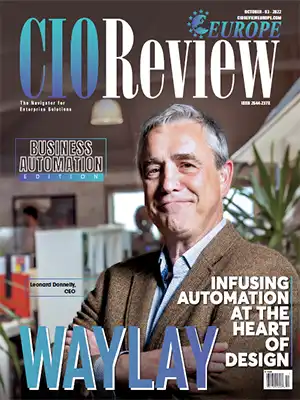
Waylay
Infusing Automation at the Heart of Design

 Leonard Donnelly, CEO
Donnelly hints at how ambitious digitalization projects come to a standstill due to the lack of a definitive plan of action pertaining to the integration and automation of technological components. For instance, heterogeneous components such as IT, OT, and data-driven technologies constitute long, perpetual integrations, which are counterproductive to the transformative efforts of businesses, necessitating an ‘automation at the heart of design’ approach to digitalization.
Donnelly and thought leaders at Waylay embody this design language in their digitalization initiatives to improve synergy between technological pillars of a business. The founder and COO of the company, Veselin Pizurica, understood these intrinsic problems early on and started working on an underlying set of rules and an automation engine to ensure maximum flexibility in orchestrating workflows between disparate data sources. By virtue of these efforts, today, the Waylay low-code automation and orchestration platform empowers industry leaders with the ability to develop applications, experiment with them across multiple use cases, and carry out seamless integrations. Created by developers for developers, the platform eliminates tedious integration processes, allowing clients to integrate any API-enabled service within their automation workflow, all the while developing a library of code snippets for orchestration.
A Winning Formula for Success
Waylay’s profound comprehension of information and operational technologies (IT and OT) enables them to interconnect the physical and the digital worlds seamlessly, deducing a winning formula to achieve enterprise automation for AI, IT and OT convergence workflows. The company has pre-built over 90 percent of all software an organization can require in building an integrated automated software environment, with the remaining 10 percent of customizations to be carried out through a low and no code approach to integration.
“Even for a very sophisticated, large-scale customer, needing more than 200 lines of code for the entire solution set, would be considered unusual when using our platform,” says Donnelly, speaking about the low- and no-code customizations their clients can carry out when onboarding the Waylay platform. This approach to integration resembles the construction of a house, which is carried out by the Waylay team, after which the doors, woodwork, and furniture are assembled by the house owners— the clients onboarding the Waylay platform.
The company has pre-built plugins and connectors for all different types of data sources that include IoT devices and gateways. Likewise, on the IT side, Waylay has developed various integrations that form the overall architecture, as necessitated by clients. The cloud agnostic business model ensures that clients need not to worry about the type of infrastructure they have in place. When prompted to conduct tasks like predictive maintenance or automating routine checks, they can effortlessly do so, irrespective of where they are located, with the assistance of just one subject matter expert—Waylay.
To understand the merit of Waylay’s automation proficiency, consider a probable deployment of this platform in a Manhattan skyscraper built with the most sophisticated and utility-driven technologies available with automated HVAC systems, resilient real-time security systems, automatic lighting and access controls, and similar conveniences. Traditionally, IoT and automation solutions configured by different vendors would not necessarily work in synchrony with one another. Obtaining actionable insights from the infrastructure to remediate an emergency would be next to impossible without a herculean effort, which more or less defeats the purpose when faced with such situations. Contrary to such integration practices, the Waylay team functions as the subject matter expert that empowers its clients to quickly drag and drop functions necessary for automation, utilizing the underlying Waylay platform as a bridge for information exchange among all disparate data sources.
In this same building, for whatever reasons, if the HVAC heat signatures go over a certain threshold, possibly indicating a fire hazard, the smoke trace detection systems relevant to the area of the incident are automatically turned on. Simultaneously, the system recognizes the number of occupants in the building, triggering an evacuation protocol through SMS alerts to staff, security and first responders. The coherence among all of the deployed sensors orchestrated by the Waylay platform generates actionable insights pertaining to where people are located. For instance, the occupancy detection system is used to understand in real-time the pathway for evacuation, thereby redirecting residents out of the building safely and quickly. Once the people are evacuated from the hazardous zones, the system helps ensure that they do not wander into those zones in panic, which is a common occurrence. Once evacuated, fire doors close and cyber keys are cancelled. Emergency services teams are informed immediately, and fire exits are activated for evacuation. Waylay also solves the problem of understanding the nature of the fire, in this case the electrical devices do not activate water sprinklers, which could cause further electrical malfunctions and more serious fire hazards.
Waylay has developed many such templates and build cases, all the while enabling clients to do the same within just 30 minutes through its low- and no-code automation platform. Alongside all these domains of innovation that bring about change, the company also creates abundant opportunities for people to be re-trained on more resourceful tasks, developing greater value for their enterprise.
To understand the merit of Waylay’s automation proficiency, consider a probable deployment of this platform in a Manhattan skyscraper built with the most sophisticated and utility-driven technologies available with automated HVAC systems, resilient real-time security systems, automatic lighting and access controls, and similar conveniences. Traditionally, IoT and automation solutions configured by different vendors would not necessarily work in synchrony with one another. Obtaining actionable insights from the infrastructure to remediate an emergency would be next to impossible without a herculean effort, which more or less defeats the purpose when faced with such situations. Contrary to such integration practices, the Waylay team functions as the subject matter expert that empowers its clients to quickly drag and drop functions necessary for automation, utilizing the underlying Waylay platform as a bridge for information exchange among all disparate data sources.
Even For A Very Sophisticated, Large-Scale Customer, Needing More Than 200 Lines Of Code For The Entire Solution Set Would Be Considered Unusual When Using Our Platform
In this same building, for whatever reasons, if the HVAC heat signatures go over a certain threshold, possibly indicating a fire hazard, the smoke trace detection systems relevant to the area of the incident are automatically turned on. Simultaneously, the system recognizes the number of occupants in the building, triggering an evacuation protocol through SMS alerts to staff, security and first responders. The coherence among all of the deployed sensors orchestrated by the Waylay platform generates actionable insights pertaining to where people are located. For instance, the occupancy detection system is used to understand in real-time the pathway for evacuation, thereby redirecting residents out of the building safely and quickly. Once the people are evacuated from the hazardous zones, the system helps ensure that they do not wander into those zones in panic, which is a common occurrence. Once evacuated, fire doors close and cyber keys are cancelled. Emergency services teams are informed immediately, and fire exits are activated for evacuation. Waylay also solves the problem of understanding the nature of the fire, in this case the electrical devices do not activate water sprinklers, which could cause further electrical malfunctions and more serious fire hazards.
Waylay has developed many such templates and build cases, all the while enabling clients to do the same within just 30 minutes through its low- and no-code automation platform. Alongside all these domains of innovation that bring about change, the company also creates abundant opportunities for people to be re-trained on more resourceful tasks, developing greater value for their enterprise.
“Being different and better than everybody else results in greater customer retention and satisfaction, which means that churn rates would automatically go down. For an industrial engineering company, this is a huge difference as even a two percent improvement in efficiency can be completely transformational,” elaborates Donnelly. For example, energy saving would be circa $1m per 1m SQM.
Automation Across All Enterprise Domains
Waylay, owing to its automation capabilities, enables its clients to seamlessly deploy automation functions across heterogenous enterprise solutions such as Salesforce, ServiceNow, Oracle and others. Enterprises have grown into a positive dependency on all such solutions and ecosystems, having made substantial investments in these IT domains. Businesses are better off not changing any of the core fields within these platforms for smooth cross-platform accessibility, thereby implementing pre-built automation functions to address specific use cases. Waylay ensures automation across these solutions through a singular, common domain—a cross-platform prowess that cannot be understated.
Customers working with AI and ML modeling would find themselves at ease in invoking those relevant functions within the Waylay platform. The company has made considerable investments in an easy-to-use canvas for IIoT, AI and data orchestration workflows, offering clients an intuitive and seamless automation experience. Be it Power BI or Tableau, or any data analytics dashboard component, Waylay guarantees a coherent, consistent and engaging user experience. Meaning the company, through its low- and no-code technology stack, allows clients to also build powerful visualization capabilities through the tools they already use.
Thanks to these resourceful automation competencies, Waylay redefines the modus operandi of software development, especially for businesses that are seldom focused on IT infrastructure development and management. For such companies, building software has inherently been a complicated endeavour without the necessary understanding of all its nuances. Waylay helps its client overcome this obstacle through a nimble approach to integration, enabling a business to redirect its resources to more valuable avenues. These functions, coupled with the utility of its low- and no-code platform that acts as the singular source of truth for all disparate data sources, Waylay inspires businesses to comfortably build, test, experiment and orchestrate a vast array of AI, IIoT, and data orchestration workflows.
Automation Across All Enterprise Domains
Waylay, owing to its automation capabilities, enables its clients to seamlessly deploy automation functions across heterogenous enterprise solutions such as Salesforce, ServiceNow, Oracle and others. Enterprises have grown into a positive dependency on all such solutions and ecosystems, having made substantial investments in these IT domains. Businesses are better off not changing any of the core fields within these platforms for smooth cross-platform accessibility, thereby implementing pre-built automation functions to address specific use cases. Waylay ensures automation across these solutions through a singular, common domain—a cross-platform prowess that cannot be understated.
-
Being Different And Better Than Everybody Else Results In Greater Customer Retention And Satisfaction, Which Means That Churns Rates Would Automatically Go Down
Customers working with AI and ML modeling would find themselves at ease in invoking those relevant functions within the Waylay platform. The company has made considerable investments in an easy-to-use canvas for IIoT, AI and data orchestration workflows, offering clients an intuitive and seamless automation experience. Be it Power BI or Tableau, or any data analytics dashboard component, Waylay guarantees a coherent, consistent and engaging user experience. Meaning the company, through its low- and no-code technology stack, allows clients to also build powerful visualization capabilities through the tools they already use.
Thanks to these resourceful automation competencies, Waylay redefines the modus operandi of software development, especially for businesses that are seldom focused on IT infrastructure development and management. For such companies, building software has inherently been a complicated endeavour without the necessary understanding of all its nuances. Waylay helps its client overcome this obstacle through a nimble approach to integration, enabling a business to redirect its resources to more valuable avenues. These functions, coupled with the utility of its low- and no-code platform that acts as the singular source of truth for all disparate data sources, Waylay inspires businesses to comfortably build, test, experiment and orchestrate a vast array of AI, IIoT, and data orchestration workflows.
| Share this Article: Tweet |

Company
Waylay
Management
Leonard Donnelly, CEO
Description
Waylay embodies an ‘automation at the heart of design’ approach to enterprise automation for IIoT, AI, and data convergence workflows. The Waylay low-code automation and orchestration platform empowers industry leaders with the ability to develop applications, experiment with them across multiple use cases, and carry out seamless integrations.
Top
