×

CIOReview Europe Weekly Brief
Be first to read the latest tech news, Industry Leader's Insights, and CIO interviews of medium and large enterprises exclusively from CIOReview Europe
This article is part of CIOReview's Innovation Insights series featuring expert contributions nominated by our subscribers and reviewed by our editorial team.
Hogwart: Mainframe Modernization Services for Business-Critical Systems
Modernizing mainframe environments is no longer optional for organizations that rely on business-critical legacy applications in banking, insurance, postal services, industry, and telecommunications. Hogwart, a Milan-based consultancy, supports enterprises in redefining their application lifecycle and infrastructure while preserving continuity of service and business know-how.
A change management–driven approach
Hogwart positions mainframe modernization within a broader process and organization review framework. The company helps management answer four key questions: what to change, how and where to change, how to plan and govern the transformation, and which solutions to adopt and how to use them.
The firm works on organizational, procedural, and operational aspects of enterprise activities, not only on technology. This holistic approach aims to increase the competitive level of the enterprise by aligning systems, processes, structures, and roles with strategic objectives.
Application Lifecycle Management and DevOps
Hogwart delivers consultancy and products around Application Lifecycle Management (ALM), focusing on both mainframe and open systems. Its portfolio covers ALM platforms, traditional mainframe lifecycle tools and modern solutions.
On top of core ALM platforms, Hogwart supports software development automation, test automation, and Secure DevOps using market-leading solutions. By integrating these tools, the company enables end-to-end lifecycle control from development through deployment, including compliance, risk, and service management dimensions.
Mainframe ALM migration projects
A key area of specialization for Hogwart is the migration of mainframe ALM environments, both within the mainframe world and toward open platforms. These projects often take place in highly regulated industries such as payments, banking, insurance, and national postal services, where reliability and auditability are essential.
Representative projects include:
• Mainframe-to-mainframe migration, including from custom mainframe ALM environments, for payments services, major banking institutions and postal organizations.
• Mainframe-to-open migration for insurance and banking clients and Mainframe-to-open transitions, during rehosting initiatives, ensuring continuity of lifecycle control while infrastructure moves off the mainframe.
• Open-to-open migration for insurance companies embracing cloud-native DevOps.
These projects demonstrate Hogwart’s ability to manage both evolutionary transformations (tool-to-tool within the mainframe) and disruptive changes involving new platforms, pipelines, and operating models.
A change management–driven approach
Hogwart positions mainframe modernization within a broader process and organization review framework. The company helps management answer four key questions: what to change, how and where to change, how to plan and govern the transformation, and which solutions to adopt and how to use them.
The firm works on organizational, procedural, and operational aspects of enterprise activities, not only on technology. This holistic approach aims to increase the competitive level of the enterprise by aligning systems, processes, structures, and roles with strategic objectives.
Application Lifecycle Management and DevOps
Hogwart delivers consultancy and products around Application Lifecycle Management (ALM), focusing on both mainframe and open systems. Its portfolio covers ALM platforms, traditional mainframe lifecycle tools and modern solutions.
On top of core ALM platforms, Hogwart supports software development automation, test automation, and Secure DevOps using market-leading solutions. By integrating these tools, the company enables end-to-end lifecycle control from development through deployment, including compliance, risk, and service management dimensions.
Mainframe ALM migration projects
A key area of specialization for Hogwart is the migration of mainframe ALM environments, both within the mainframe world and toward open platforms. These projects often take place in highly regulated industries such as payments, banking, insurance, and national postal services, where reliability and auditability are essential.
Representative projects include:
• Mainframe-to-mainframe migration, including from custom mainframe ALM environments, for payments services, major banking institutions and postal organizations.
• Mainframe-to-open migration for insurance and banking clients and Mainframe-to-open transitions, during rehosting initiatives, ensuring continuity of lifecycle control while infrastructure moves off the mainframe.
• Open-to-open migration for insurance companies embracing cloud-native DevOps.
These projects demonstrate Hogwart’s ability to manage both evolutionary transformations (tool-to-tool within the mainframe) and disruptive changes involving new platforms, pipelines, and operating models.
Other mainframe migration projects
Beyond ALM-focused transformations, Hogwart manages a broad spectrum of application and data migrations involving mainframe technologies. The company supports language conversions, database migrations, rehosting, and batch/job control transitions as part of comprehensive modernization programs.
Typical initiatives include:
• Program transformation from Easytrieve to COBOL.
• Application transformation from COBOL to PL/SQL.
• Migration from DB2 on mainframe to Oracle on open systems, combined with related COBOL program conversion.
• Rehosting from Bull mainframe to Unix/Linux, including Bull COBOL to Micro Focus COBOL translation and TP Bull to Tuxedo.
• Migration from Bull mainframe to IBM AIX, moving TPFORM to IBM Forms and DMIV to DB2.
• Conversion of mainframe JCL to shell scripts or Windows batch.
These services are valuable for organizations seeking to reduce mainframe operational costs, adopt open technologies, and improve transparency across complex application portfolios.
Methdology,migration Engines and best practices
Hogwart applies a linear, stepwise methodology, combining project management discipline with technical depth. The method supports distributed teams, both on-site and remote, and emphasizes alignment on plans, risks, and communication.
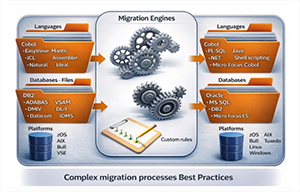
To handle complex, large-scale migrations, Hogwart employs dedicated “Migration Engines” based on a combination of technology coverage and custom rules. These engines support multiple legacy languages, databases, and platforms, enabling consistent and repeatable transformations to target environments.
On the source side, they handle languages such as COBOL, Easytrieve, Mantis, JCL, Assembler, Natural, and Ideal; databases and file systems including DB2, ADABAS, DLI, VSAM, Datacom, DMIV, and IDMS; and platforms like z/OS, AIX, Bull, and VSE. On the target side, they produce Java, COBOL, PL/SQL, .NET, shell scripting, and Micro Focus COBOL, together with databases such as Oracle, MS SQL, and DB2, running on environments like z/OS, AIX, Tuxedo, Linux, Windows, and Micro Focus Enterprise Server.
These engines embody best practices for complex migration processes, reducing manual effort, lowering risk, and improving quality and consistency of converted artifacts. This industrialized approach is essential when modernizing thousands of components while keeping business operations live.
A trusted partner
Hogwart’s experience spans financial, insurance, industrial, university, editorial, telecommunications, and e-commerce sectors, with a strong focus on change management and IT governance. The company is ISO 9001 certified, reinforcing its commitment to quality and structured processes.
By combining organizational consulting, ALM expertise, migration tooling, and robust methodologies, Hogwart positions itself as a trusted partner for enterprises modernizing mainframe environments without sacrificing stability, compliance, or business continuity.
Beyond ALM-focused transformations, Hogwart manages a broad spectrum of application and data migrations involving mainframe technologies. The company supports language conversions, database migrations, rehosting, and batch/job control transitions as part of comprehensive modernization programs.
Typical initiatives include:
• Program transformation from Easytrieve to COBOL.
• Application transformation from COBOL to PL/SQL.
• Migration from DB2 on mainframe to Oracle on open systems, combined with related COBOL program conversion.
• Rehosting from Bull mainframe to Unix/Linux, including Bull COBOL to Micro Focus COBOL translation and TP Bull to Tuxedo.
• Migration from Bull mainframe to IBM AIX, moving TPFORM to IBM Forms and DMIV to DB2.
• Conversion of mainframe JCL to shell scripts or Windows batch.
These services are valuable for organizations seeking to reduce mainframe operational costs, adopt open technologies, and improve transparency across complex application portfolios.
-
At Hogwart, we transform decades of mainframe investment into a modern, agile, and governed IT ecosystem, combining deep technical expertise with structured project methodologies to minimize risk and maximize business value.
Methdology,migration Engines and best practices
Hogwart applies a linear, stepwise methodology, combining project management discipline with technical depth. The method supports distributed teams, both on-site and remote, and emphasizes alignment on plans, risks, and communication.
To handle complex, large-scale migrations, Hogwart employs dedicated “Migration Engines” based on a combination of technology coverage and custom rules. These engines support multiple legacy languages, databases, and platforms, enabling consistent and repeatable transformations to target environments.
On the source side, they handle languages such as COBOL, Easytrieve, Mantis, JCL, Assembler, Natural, and Ideal; databases and file systems including DB2, ADABAS, DLI, VSAM, Datacom, DMIV, and IDMS; and platforms like z/OS, AIX, Bull, and VSE. On the target side, they produce Java, COBOL, PL/SQL, .NET, shell scripting, and Micro Focus COBOL, together with databases such as Oracle, MS SQL, and DB2, running on environments like z/OS, AIX, Tuxedo, Linux, Windows, and Micro Focus Enterprise Server.
These engines embody best practices for complex migration processes, reducing manual effort, lowering risk, and improving quality and consistency of converted artifacts. This industrialized approach is essential when modernizing thousands of components while keeping business operations live.
A trusted partner
Hogwart’s experience spans financial, insurance, industrial, university, editorial, telecommunications, and e-commerce sectors, with a strong focus on change management and IT governance. The company is ISO 9001 certified, reinforcing its commitment to quality and structured processes.
By combining organizational consulting, ALM expertise, migration tooling, and robust methodologies, Hogwart positions itself as a trusted partner for enterprises modernizing mainframe environments without sacrificing stability, compliance, or business continuity.
MORE FROM INNOVATION INSIGHTS

Naviam
Phil Runion, Technical Product Manager
Why Global Infrastructure Requires a Shift from Local Systems to Connected, Scalable Platforms

Merit Data Tech
Tharun Mathew, Head Data & AI Solutions
Why General AI Fails the Enterprise: The Case for Domain-Specific AI

Maltego Technologies
Aaron Dixon, Senior Cyber Intelligence Expert
Avoiding Cognitive Biases in Your Investigations Using Maltego's Data-Driven Solution

WorkSmartr
Bernadine Racoma is the Content Manager
Le intelligenze artificiali arrivano su WhatsApp con Copilot
EXPLORE OUR KNOWLEDGE NETWORK
The articles from these contributors are based on their personal expertise and viewpoints, and do not necessarily reflect the opinions of their employers or affiliated organizations.
Top
